Book Categories:

Middle East Post-War Reconstruction: Opportunities for Chinese Construction Machinery Export
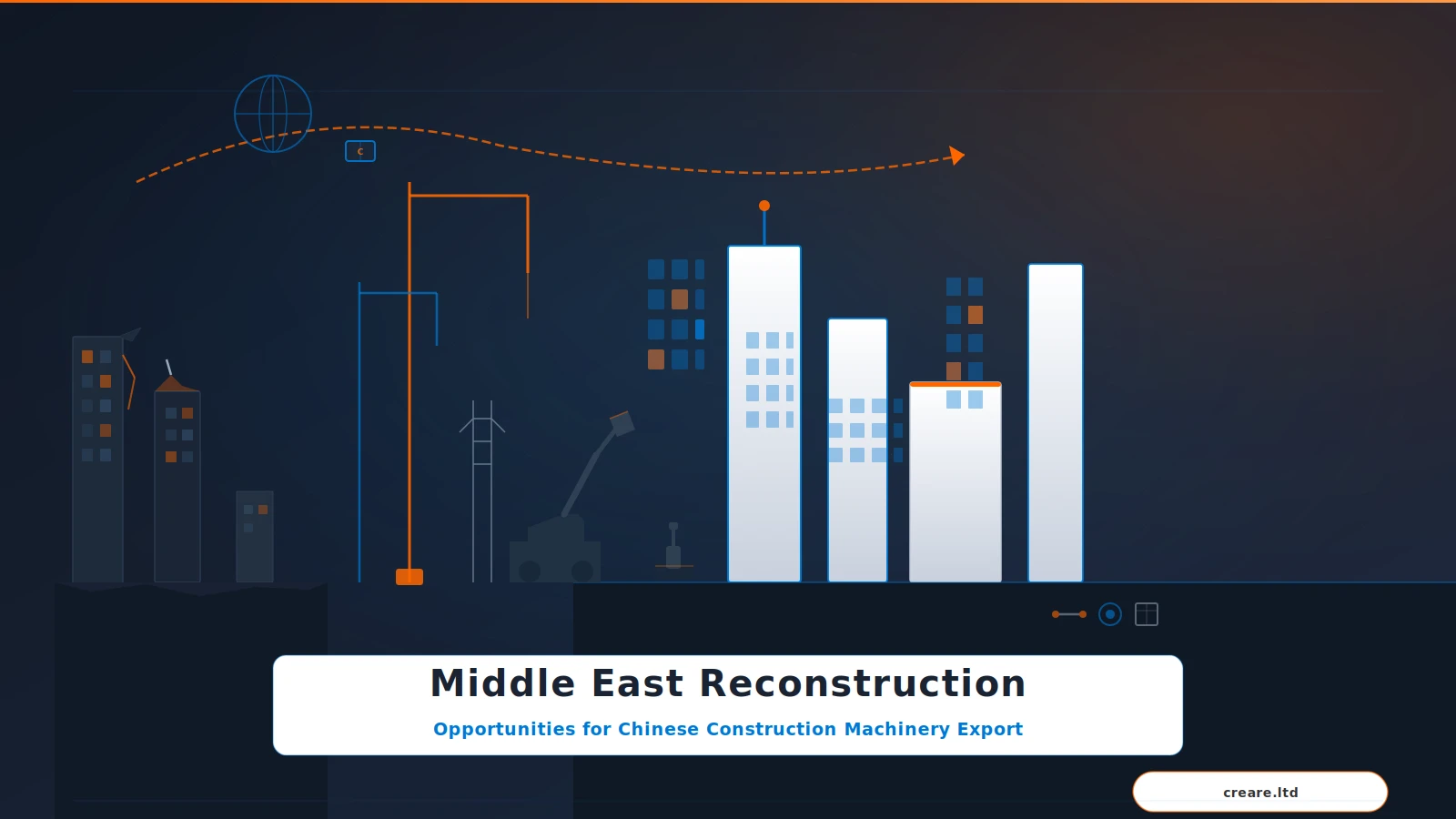
Table of Contents
Introduction: A Region at a Turning Point
Key takeaway: The US-Israel-Iran conflict that began on February 28, 2026, has now exceeded 90 days, causing extensive damage to critical infrastructure across the Middle East. With diplomatic negotiations advancing toward a ceasefire, the region stands at the threshold of one of the largest reconstruction efforts in recent history — creating significant opportunities for construction machinery exporters worldwide.
The conflict has not only disrupted global energy markets but has also devastated roads, bridges, housing, water systems, and power infrastructure in affected areas. As ceasefire talks progress in Geneva — with diplomatic sources indicating that both parties have reached preliminary consensus — attention is shifting from immediate humanitarian concerns to the immense task of rebuilding.
For Chinese construction machinery manufacturers, this represents a potentially transformative market opportunity. China’s established trade relationships in the region, combined with its manufacturing capacity and competitive pricing, position its equipment exporters to play a meaningful role in the reconstruction effort.
According to the World Bank’s historical data on post-conflict reconstruction, the cost of rebuilding infrastructure in conflict-affected Middle Eastern regions typically ranges from 150% to 300% of pre-conflict GDP in the affected areas. This translates into sustained, multi-year demand for construction equipment, materials, and expertise.
The Reconstruction Landscape
Reconstruction in post-conflict zones follows a well-documented pattern, moving from emergency response to physical rebuilding over a period of years. The Middle East reconstruction effort will likely unfold across several phases, each with distinct equipment requirements.
USD 15–25 Billion
Estimated additional construction equipment demand over the next 5–7 years in conflict-affected regions, according to industry analysts
Estimated additional construction equipment demand over the next 5–7 years in conflict-affected regions, according to industry analysts
Priority Reconstruction Sectors
Transportation infrastructure — roads, bridges, and ports — is typically the first priority, as functioning logistics networks are essential for all other rebuilding efforts. This creates immediate demand for concrete processing equipment, compaction machinery, and steel bar processing tools.
Housing and urban infrastructure follows closely. The United Nations estimates that over 2 million housing units have been damaged or destroyed in the conflict zones. Rebuilding at this scale requires sustained access to reinforcement steel processing equipment — straightening, cutting, and bending machines — plus concrete finishing tools such as power trowels and vibrators.
Energy and water systems represent the third major category. Damaged power plants, water treatment facilities, and pipeline networks will require specialized construction approaches, further expanding the equipment demand pool.
The Middle East construction equipment market was valued at approximately USD 8.5 billion in 2025. Post-conflict reconstruction could add substantial incremental demand, particularly in the small to medium machinery segment where rapid deployment and operational flexibility are critical advantages.
Opportunities for Chinese Construction Machinery
Chinese construction machinery manufacturers are uniquely positioned to capture a significant share of the Middle East reconstruction equipment market. Several structural factors support this outlook.
Value Proposition: Competitive Pricing Meets Advancing Technology
The traditional advantage of Chinese machinery — competitive pricing — has been strengthened in recent years by significant improvements in manufacturing quality and technological sophistication. Modern Chinese equipment increasingly incorporates intelligent control systems, energy-efficient designs, and durable components that meet international standards. This combination of affordability and capability is precisely what large-scale reconstruction projects demand.
Equipment Categories with Strongest Demand
Steel bar processing equipment is projected to see the highest demand growth. Reinforced concrete remains the dominant construction method in the Middle East, and every rebuilding project — from highway overpasses to residential buildings — requires processed reinforcement steel. The full workflow involves straightening, cutting to specified lengths, hoop bending for columns and beams, and thread rolling for mechanical splicing connections. Manufacturers offering compact, integrated machines that combine multiple processing steps — straightening, cutting, and hoop bending in a single unit — offer particular logistical and operational advantages for reconstruction sites where space and skilled labor may be limited.
Concrete finishing and surface preparation equipment represents the second major category. Power trowels for floor finishing, concrete vibrators for proper consolidation, and floor grinders or milling machines for surface preparation are essential across all phases of rebuilding. Plate compactors for soil and asphalt compaction round out the core equipment set needed on virtually every reconstruction site.
The preference for compact, intelligent machinery in reconstruction scenarios is well-established: smaller equipment is easier to transport to damaged areas with compromised infrastructure, requires less skilled operation, and can be deployed across multiple decentralized work sites simultaneously.
Machinery in Focus: Equipment for Reconstruction
The following equipment categories represent the core machinery types most relevant to post-conflict rebuilding. Chinese manufacturers specializing in these areas — particularly those offering compact, intelligent designs — are well-positioned for the reconstruction market:
- Steel Bar Straightening, Cutting & Hoop Bending Machines
- Steel Bar Straightening & Cutting Machines
- Steel Bar Rib-peeling Parallel Thread Rolling Machines
- Steel Bar Cutting Machines
- Steel Bar Bending Machines
- Power Trowels
- Plate Compactors
- Milling Machines (Floor Grinders)
- Cutting Machines (Concrete)
- Concrete Vibrators
Logistics and Trade Infrastructure
China’s existing trade infrastructure in the Middle East — strengthened by years of Belt and Road Initiative engagement — provides a meaningful advantage. Established shipping routes, port relationships, and trade finance channels reduce the barriers to market entry that manufacturers from other regions face.
Furthermore, the geographical proximity of Chinese manufacturing centers to Middle Eastern markets, compared to European or American competitors, translates into shorter shipping times and lower logistics costs — factors that become particularly significant for large-volume equipment orders in reconstruction scenarios.
SWOT Analysis: Chinese Machinery in the Middle East Market
The following SWOT analysis evaluates the competitive position of Chinese construction machinery manufacturers — particularly small to medium-sized enterprises — in the Middle East post-war reconstruction market. The analysis draws on current trade data, industry reports, and the specific characteristics of post-conflict procurement environments.
Strengths
- Cost competitiveness — 30–50% price advantage over European equivalents for comparable specifications
- Manufacturing scale — capacity to fulfill large-volume orders on short timelines
- Product range breadth — comprehensive coverage from steel processing to concrete finishing to compaction
- Compact equipment specialization — small to medium machinery ideal for decentralized reconstruction
- Improving technology — intelligent controls and energy-efficient designs increasingly standard
Weaknesses
- Brand perception — some procurement decision-makers still default to European or Japanese brands for perceived reliability
- After-sales infrastructure — limited service networks in certain Middle Eastern countries
- Certification gaps — varying and sometimes unfamiliar certification requirements across GCC and non-GCC markets
- Language and cultural barriers — fewer Arabic-speaking technical support personnel compared to regional competitors
Opportunities
- Massive reconstruction demand — multi-year, multi-billion-dollar rebuilding programs across multiple countries
- Budget sensitivity — reconstruction budgets favor cost-effective equipment solutions over premium brands
- Belt and Road momentum — Chinese contractors already active in regional infrastructure projects specify familiar equipment
- Technology leapfrogging — opportunity to establish smart, connected machinery as the new standard in rebuilt infrastructure
- Niche positioning — small to medium equipment manufacturers specializing in steel processing and concrete finishing can capture specific high-demand segments without competing head-to-head with heavy equipment giants
Threats
- European and Turkish competition — established regional presence with existing service networks and customer relationships
- Geopolitical uncertainty — shifting alliances and sanctions could affect market access
- Currency and payment risks — volatility in regional currencies and complex trade finance in post-conflict economies
- Local content requirements — some governments may mandate local manufacturing or assembly partnerships
- Logistics disruption — damaged port and road infrastructure complicates equipment delivery to project sites
Challenges & Strategic Recommendations
Despite the substantial opportunities, Chinese manufacturers face real challenges in accessing and sustaining presence in the Middle East reconstruction market. Addressing these proactively is essential for converting opportunity into long-term market share.
Key Challenges
Certification and compliance presents the first hurdle. Middle Eastern countries maintain diverse technical standards — GCC member states follow GSO (GCC Standardization Organization) regulations, while non-GCC markets such as Iraq and Iran have their own requirements. Navigating this patchwork demands investment in compliance infrastructure that many smaller manufacturers have not yet made.
After-sales service is the second critical challenge. Reconstruction projects cannot tolerate extended equipment downtime. Manufacturers that enter the market without local service partners, spare parts inventory, and Arabic-speaking technical support will struggle to build the trust necessary for sustained procurement relationships.
Geopolitical risk remains a factor. The Middle East’s political landscape is dynamic, and manufacturers must monitor sanctions regimes, trade restrictions, and diplomatic developments that could affect their ability to operate in specific markets.
Strategic Recommendations
1. Partner with local distributors who have existing relationships with construction firms and government procurement agencies. This accelerates market entry and provides immediate after-sales service capability.
2. Invest in certification proactively. Securing GSO compliance, CE marking equivalents, and country-specific certifications before bidding on projects eliminates a common disqualification point.
3. Establish regional spare parts depots in logistics hubs such as Dubai or Dammam. Rapid parts availability is one of the strongest competitive differentiators in the reconstruction equipment market.
4. Focus on compact, multi-function equipment. The reconstruction environment favors machines that are easy to transport, quick to deploy, and capable of performing multiple tasks. This is an area where Chinese manufacturers have a natural advantage over competitors focused on large-scale heavy equipment.
5. Build digital presence for discoverability. Procurement officers and project managers increasingly research equipment suppliers online before initiating contact. A well-optimized web presence with detailed specifications, case studies, and clear contact channels is essential for being found in this competitive landscape.
Conclusion
The approaching end of the US-Israel-Iran conflict will open a substantial window of opportunity in the Middle East construction machinery market — potentially the largest single regional demand surge in a decade. Chinese manufacturers, with their cost advantages, expanding technological capabilities, and established trade infrastructure, are well-positioned to participate meaningfully in the reconstruction effort.
Success will depend not just on having the right equipment, but on addressing the practical challenges of certification, service infrastructure, and local partnership development. The manufacturers that invest in these areas now — before reconstruction contracts are awarded — will be the ones that capture lasting market share rather than opportunistic one-time sales.
Looking for Construction Machinery for Your Reconstruction Project?
Explore our range of steel bar processing, concrete finishing, and compaction equipment — designed for reliability in demanding environments.
Frequently Asked Questions
What construction machinery is needed for Middle East post-war reconstruction?
Key equipment categories include steel bar processing machines (straightening, cutting, bending), concrete equipment (vibrators, power trowels, floor grinders), compaction equipment (plate compactors), and concrete cutting machines. Compact, intelligent machinery is particularly valued for its logistics efficiency and suitability for decentralized rebuilding projects.
Why are Chinese construction machinery manufacturers well-positioned for Middle East reconstruction?
Chinese manufacturers offer a compelling value proposition combining competitive pricing with increasingly sophisticated technology. Their strength in small to medium-sized equipment aligns with the decentralized nature of reconstruction projects. Additionally, China’s established trade relationships and Belt and Road Initiative infrastructure provide logistics and financing advantages.
What are the main challenges for exporting construction machinery to the Middle East?
Key challenges include navigating varying certification requirements across Middle Eastern countries, establishing reliable after-sales service networks, managing logistics in regions with damaged infrastructure, and addressing geopolitical uncertainties. Companies should also prepare for competition from established European and Turkish manufacturers with existing regional presence.
How large is the Middle East construction machinery market?
The Middle East construction equipment market was valued at approximately USD 8.5 billion in 2025, according to industry estimates. Post-conflict reconstruction in affected regions could add USD 15–25 billion in additional demand over the next 5–7 years, particularly for steel processing, concrete, and earthmoving equipment.
What types of steel bar processing equipment are in highest demand for reconstruction?
Steel bar straightening and cutting machines, hoop bending machines, and rib-peeling thread rolling machines are in highest demand. These are essential for reinforced concrete structures — the dominant construction method in the Middle East. Compact, multi-function machines that combine straightening, cutting, and bending capabilities offer particular logistical advantages.
Published by Henan Creare Electromechanical Equipment Co., Ltd. —
Specializing in small to medium construction machinery for global markets.