Book Categories:
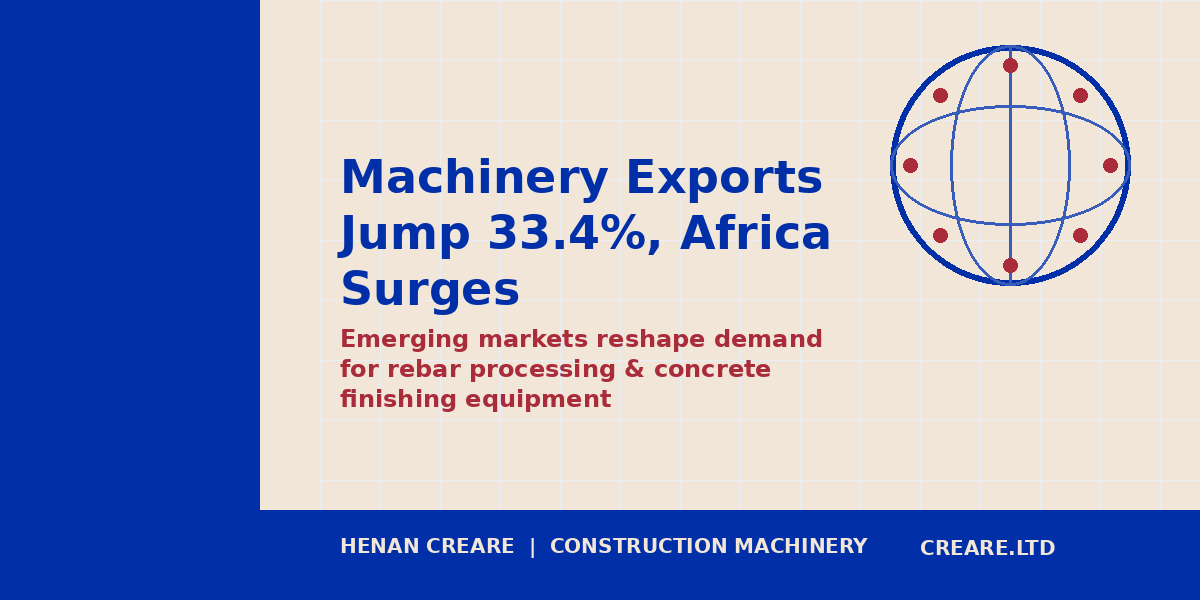
China’s construction machinery sector has opened 2026 with its strongest export signal in years. According to official customs data, exports of construction machinery surged 33.4% year-on-year in the first two months of the year, reaching $10.686 billion. On the surface, that number confirms a sector in recovery. But the real story lies in the regional breakdown: exports to Africa jumped 77%, followed by Oceania at 50.6% and Europe at 28.1%. For manufacturers of steel bar processing machinery, concrete finishing equipment, and compaction tools — companies like Henan Creare — the data confirms what months of Belt and Road reports have been hinting at: the center of gravity for small and mid-sized construction machinery demand is shifting decisively toward emerging markets.
Africa Is No Longer a "Future" Market
The 77% surge in African exports is not an isolated spike. It sits directly on top of the Green Finance & Development Center’s 2026 H1 Belt and Road Initiative report, which found that African countries received $33.5 billion in Chinese investment — nearly triple the figure from H1 2025 and the highest ever recorded. Africa’s urbanization rate is the fastest of any region on earth, and the African Development Bank estimates the continent needs between $130 billion and $170 billion in infrastructure investment every single year.
Every one of those funded projects creates a localized demand center for equipment. A single road contract in Kenya or Ethiopia requires plate compactors for subgrade consolidation, concrete vibrators for culvert and drainage structures, power trowels for bridge deck finishing, and concrete cutting machines for expansion joint installation. Multiply that across dozens of simultaneous projects, and the equipment requirement becomes concrete and urgent.
For African buyers, the sourcing calculus has fundamentally changed. A decade ago, purchasing construction machinery meant choosing between premium-priced European brands and unproven budget alternatives. Today, Chinese manufacturers offer a third path: machines engineered for exactly the operating conditions found on African sites — dust, high temperatures, voltage fluctuation, and operators with limited formal training — backed by supply chains that can deliver spare parts in days rather than weeks.
Mega-Projects Run on Small Equipment
Industry commentary around emerging-market construction tends to fixate on the dramatic: tunnel boring machines, massive crawler cranes, fifty-ton excavators. But anyone who has actually managed a construction site knows that mega-projects run on small equipment.
Consider the rebar problem. Every reinforced concrete structure — from a highway culvert to a thirty-story residential tower — requires steel reinforcement bars that have been straightened, cut to length, and bent to specification. A single elevated metro station can contain more than a thousand tons of rebar. None of that rebar arrives on site ready to install. It must be processed, and processing requires steel bar straightening and cutting machines, steel bar bending machines, hoop bending machines, and thread rolling machines for mechanical rebar connections.
This is precisely the equipment category where mid-sized Chinese manufacturers hold their strongest competitive advantage. The "small yet beautiful" (小而美) machinery that official BRI channels once championed — and that some analysts now consider overshadowed by the return of mega-projects — is in fact the workhorse of every large project. The two are not in tension. A $4 billion port development still needs hundreds of plate compactors for backfill consolidation. An $8 billion high-speed rail line still needs thousands of power trowels to finish station platforms and warehouse floors.
The Middle East and Green Steel: A Second Engine
The Middle East added a second engine of demand in H1 2026, topping the BRI construction engagement rankings with a record $36.5 billion. Even as some headline-grabbing vanity projects — most notably NEOM’s The Line, which Saudi Arabia scaled back in 2026 after spending roughly $50 billion — have been suspended or re-scoped, the underlying infrastructure spending on ports, logistics hubs, housing, and energy continues at record levels.
The most consequential development for machinery demand, however, is in steel. The metals and mining sector reached a record $21.8 billion in H1 2026, concentrated in steel production in Egypt and aluminum in Kazakhstan. Egypt is now at the center of a green steel wave sweeping the MENA region: a planned 2.5-million-ton direct reduced iron plant (with scope to expand to 4 million tons) is part of a broader effort to position North Africa as the EU’s preferred source of low-carbon steel. Egypt absorbed roughly 8.35 million tonnes of steel in 2026 alone.
The machinery implication is direct. Where steel is produced, rebar is processed. Where rebar is processed, steel bar straightening machines, cutting machines, and bending machines are required. The industrialization of green steel in North Africa is not just a steel story — it is a downstream construction equipment story, and it is unfolding now.
What This Means for Buyers and Exporters
The convergence of three forces — record BRI construction engagement, a 33.4% export surge, and the industrialization of green steel across the MENA region — points to a multi-year demand window for small and mid-sized construction machinery. For buyers in Africa and the Middle East, the practical question is no longer whether to source from China, but how to source reliably. The differentiators that matter now are durability in harsh conditions, fast spare parts availability, and machines that can be operated effectively with minimal training.
For exporters, the data carries a strategic warning. The days when price alone won African and Middle Eastern orders are ending. Buyers in these markets increasingly evaluate total cost of ownership — including downtime, parts lead time, and operator retraining — not just the invoice price. Manufacturers that can document durability, offer configurable specifications for local voltage and dust conditions, and maintain responsive parts logistics will capture the growth. Those that cannot will watch it go elsewhere.
A Leading Indicator, Not a Lagging One
The 33.4% export jump — and the 77% African surge inside it — is a leading indicator, not a lagging one. The contracts behind the BRI construction boom are already signed. The equipment to build those projects is being ordered right now, and the orders are flowing disproportionately toward manufacturers positioned in steel bar processing, concrete finishing, and compaction.
For companies like Henan Creare, the message is unambiguous. The demand center of gravity for small and mid-sized construction machinery has moved decisively toward Africa, the Middle East, and the other emerging markets that are now driving the single largest infrastructure build-out in modern history. The window is open. The question is not whether demand will materialize — the customs data says it already has. The question is whether manufacturers are prepared to meet it with the right products, the right support infrastructure, and the right market access strategy.
Data sources: General Administration of Customs construction machinery export data (January–February 2026); Green Finance & Development Center BRI Investment Report 2026 H1; china-insights.org construction machinery export analysis; construction industry coverage July–August 2026.