Book Categories:

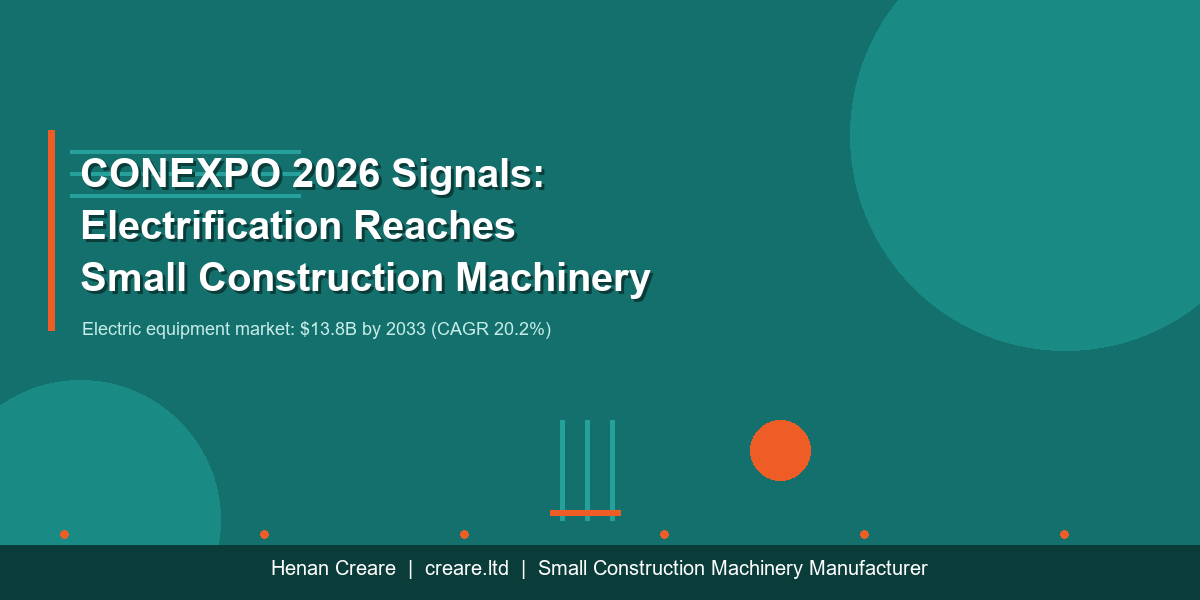
CONEXPO 2026 Confirms It: Electrification Is Now a Small Construction Machinery Imperative
When more than 140,000 construction professionals gathered in Las Vegas for CONEXPO-CON/AGG 2026, the industry’s largest trade show did not produce a single dominant machine that stole every headline. Instead, it confirmed something quieter but far more consequential: the trends that have been reshaping construction for years — electrification, artificial intelligence, and autonomy — have now moved from the concept stage into the commercial mainstream. Crucially, that wave is no longer confined to massive earthmoving equipment. It is reaching the compact, everyday machines that do the real work on residential, commercial, and infrastructure sites around the world.
For manufacturers of small construction machinery — rebar benders and cutters, power trowels, plate compactors, concrete vibrators, floor grinders, and concrete cutting machines — this shift is not a distant forecast. It is a present-day purchasing criterion. This article unpacks what the CONEXPO 2026 signals and the latest market data mean for compact equipment, and what buyers and distributors should watch for.
The electrification wave is now measurable
The numbers have stopped being projections and started being a market. According to MarketsandMarkets, the electric construction equipment market was worth an estimated USD 3.81 billion in 2026 and is forecast to reach USD 13.81 billion by 2033, a compound annual growth rate of 20.2 percent. Analysts at IDTechEx go further on the supply side, predicting that total battery demand for off-highway machines will reach 44.7 GWh by 2036, with battery revenue for construction, agriculture, and mining machines growing to USD 6.54 billion at a CAGR of 21.6 percent.
In China, which remains the world’s largest producer of construction machinery, the shift is equally pronounced. Leading domestic manufacturers have now deployed full technical routes — pure electric, hybrid, and hydrogen — across mining, infrastructure, municipal engineering, and port operations, with clear energy-saving and economic advantages. A fuel-to-electricity transition that once centered on mining trucks and large excavators is now filtering down into the compact machine segment, including steel bar processing, concrete finishing, and compaction equipment.
Why small machines are the natural first movers
There is a practical reason the electrification wave reaches compact equipment first: small construction machinery is, in many ways, the ideal candidate for electric power. Three factors stand out.
First, indoor and confined-space operation. Power trowels, floor grinders, and concrete vibrators frequently run inside enclosed buildings, tunnels, and basements where diesel exhaust is both a health hazard and, increasingly, a regulatory violation. Electric motors eliminate emissions at the point of use, which is precisely why indoor concrete finishing and grinding have been among the fastest categories to electrify.
Second, energy demand matches battery economics. A plate compactor or rebar cutting machine has a far smaller and more predictable energy draw than a 40-ton excavator. That means batteries can be sized, charged, and swapped economically, and the payback from lower fuel and maintenance costs arrives much sooner. For a contractor running a floor grinder or power trowel all day on a residential slab, the operating-cost advantage of electric over gasoline is immediate and visible.
Third, the noise and vibration reductions that come with electric drive matter most on small sites. Urban infill projects, hospital additions, and school renovations all carry strict noise windows. Electric small construction machinery lets crews start earlier and work later, turning a compliance constraint into a productivity advantage.
The demand side is rising alongside the supply shift
The electrification of small construction machinery is happening against a backdrop of sustained demand for the concrete and steel work these machines perform. Mordor Intelligence values the global construction equipment market at USD 192.59 billion in 2025, rising to a projected USD 283.22 billion by 2031 — a 6.64 percent CAGR driven largely by sustained infrastructure investment. On the materials side, the World Steel Association expects global steel demand to rebound in 2026, led by developing economies and a strong construction sector, with visible strength in markets like Egypt and other emerging economies where rebar prices have firmed.
That demand has a clear geographic concentration. The Belt and Road Initiative continues to funnel capital into infrastructure corridors — one research dataset now tracks 233 BRI projects representing USD 551.7 billion of investment — while metro and railway expansion across China, India, and Southeast Asia is pulling in precast concrete, reinforcement steel, and the small machines that process them. From Expo 2030 Riyadh’s master plan in Saudi Arabia to urban transit programs in emerging Asia, the common thread is rebar to bend and cut, slabs to trowel and grind, and concrete to vibrate and compact. That is precisely the daily workload of small construction machinery.
The intelligence layer is arriving at the compact end
CONEXPO 2026 also made clear that electrification is arriving alongside a second, parallel shift: the embedding of sensors, connectivity, and AI-assisted controls into equipment that was once purely mechanical. For large fleets this has meant telematics and autonomous earthmoving. For small construction machinery, the more relevant applications are simpler but no less valuable.
Rebar bending machines increasingly feature automated counting, length measurement, and batch programming, reducing material waste and labor cost on every bar. Power trowels and plate compactors are adopting machine health monitoring that flags maintenance needs before a failure stalls a job. Floor grinders and concrete cutting machines are integrating variable-speed control and dust management systems that improve both finish quality and operator safety.
The strategic message for distributors and buyers is straightforward: the machines that will hold their value and win specifications over the next five years are the ones built on an electric-first, intelligent-first platform. Buying purely mechanical, purely fuel-powered equipment today risks early obsolescence in a segment where the upgrade cycle is accelerating.
What this means for procurement
For contractors and importers evaluating small construction machinery in 2026, three criteria deserve the most attention.
Motor and drive quality. An electric machine is only as good as its motor and battery management. Buyers should verify motor efficiency ratings, battery cell sourcing, and, for machines that run continuously, whether the design supports quick battery swapping or extended runtime.
Build quality around the electric platform. A well-engineered rebar bender or plate compactor must be reinforced for the torque characteristics of electric drive — not simply a diesel chassis with a motor bolted on. Frame rigidity, heat dissipation, and vibration isolation all change when the power source changes.
Serviceability and parts. Electrification extends machine life, but it also concentrates complexity in fewer components. The practical question is whether the manufacturer provides clear service documentation, a reliable parts channel, and responsive technical support — factors that matter more than a marginal price difference over a machine’s lifetime.
Conclusion
The signals from CONEXPO-CON/AGG 2026 and the 2026 market data point in the same direction: electrification and intelligence are no longer optional features for small construction machinery. They are becoming the baseline expectation of contractors and the filter through which distributors select suppliers. For a manufacturer, the opportunity is clear — build compact machines that are electric-first, intelligently controlled, and serviceable, and they will meet the market where it is heading.
For Henan Creare, a manufacturer of small construction machinery spanning steel bar processing, concrete finishing, compaction, and cutting equipment, this is the design philosophy behind every product line. As the electrification wave reaches the compact end of the market, we are building the machines that help contractors finish faster, work cleaner, and operate at a lower total cost.
Contact Henan Creare today to learn how our electric-first small construction machinery can strengthen your next project’s productivity, compliance, and bottom line.