Book Categories:

When the China Construction Machinery Association (CCMA) released its January-February 2026 trade data in April, the numbers stopped more than a few industry observers mid-scroll: $10.686 billion in exports, up 33.4% year-on-year. Total trade in construction machinery products reached $11.072 billion—a 31.4% jump—and this happened during a period that included the Chinese New Year holiday, when factories and ports historically slow to a crawl. The February monthly export figure alone exceeded $5.1 billion, topping the 2025 monthly average of $5.016 billion.
Combine that with a separate headline from May: the Belt and Road Initiative (BRI) has entered what Reuters calls a “resurgent” phase, with deals reaching a record $213 billion in 2025, driven by smaller, equity-backed projects and a strategic pivot toward compatible international standards. These two data points are not coincidental. They represent the same tectonic shift: the global construction equipment supply chain is being reshaped, and Chinese manufacturers—particularly those in the compact and small machinery segment—are standing at the center of it.
The Numbers Behind the Boom
The export surge is broad-based, but the regional breakdown tells the real story. Exports to Africa jumped 77%, Oceania 50.6%, and Europe 28.1%. A total of $4.638 billion—43.4% of all construction machinery exports—flowed to Belt and Road partner countries, up 24.6% year-on-year. There is a clear structural shift underway: growth momentum is rotating from traditional developed markets toward fast-growing emerging economies in Africa, Southeast Asia, and Latin America.
For context, the global construction machinery market was valued at approximately $232.54 billion in 2025 and is projected to reach $245.47 billion in 2026, with a compound annual growth rate (CAGR) of 5.83%. The JPMorgan Global Manufacturing PMI climbed to 51.9% in February 2026, its seventh consecutive month above the 50-point expansion threshold. Construction equipment is, as Bank of America analysts note, “among the first subsectors to recover” in a new manufacturing cycle.
But the headline excavator numbers—12.98 billion yuan in export value, 29.7% growth—only capture part of the picture. Behind the heavy iron, a quieter but equally significant transformation is unfolding in the compact and small machinery segment, where products like concrete vibrators, power trowels, plate compactors, rebar processing machines, and floor grinders are finding new demand across an expanding map of infrastructure projects.
The BRI’s New Phase: Smaller Projects, Bigger Opportunity
The Belt and Road Initiative is evolving. Gone are the days of headline-grabbing megaprojects that dominated the initiative’s first decade. The new BRI, as Reuters’ Breakingviews column documented in May 2026, is characterized by smaller, more numerous projects, greater use of equity financing, and an emphasis on technical standards compatibility with host countries. The $213 billion record was achieved not through a handful of massive dams and railways, but through a proliferation of mid-scale infrastructure developments: urban roads, municipal buildings, water treatment facilities, housing complexes, and industrial parks.
This shift matters enormously for small and medium-sized construction machinery manufacturers. Megaprojects demand the largest excavators, the heaviest bulldozers, the tallest cranes—equipment categories dominated by industry giants like Caterpillar, Komatsu, XCMG, and SANY. But smaller, distributed infrastructure projects require a different equipment mix: concrete finishing tools, soil and asphalt compaction equipment, rebar cutting and bending machines, concrete vibration systems, and floor preparation machinery. These are precisely the product categories where specialized manufacturers like Henan Creare operate.
A road-widening project in Kenya, a municipal building in Bangladesh, a housing development in Uzbekistan—these projects do not need a 50-ton excavator. They need reliable, cost-effective compact equipment that can be shipped in standard containers, assembled on-site with minimal training, and maintained with locally available parts. This is the sweet spot for Chinese small machinery exporters.
Electrification: The Next Frontier for Compact Equipment
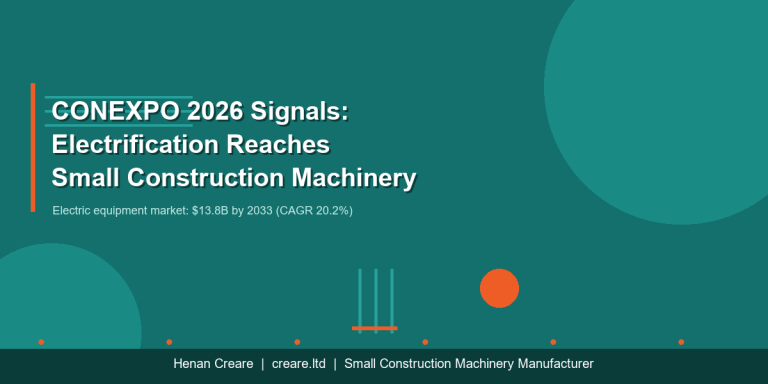
Parallel to the export boom, another force is reshaping the construction equipment landscape: electrification. The global electric construction equipment market, valued at approximately $3.81 billion in 2026, is projected to reach $13.81 billion by 2033 at a CAGR of 20.2%, according to MarketsandMarkets. P&S Market Research offers an even more bullish forecast of $62.2 billion by 2032, growing at 22.2% annually.
Europe is leading the regulatory push. The EU’s tightening emissions and noise regulations are making battery-powered equipment a compliance necessity for urban construction sites. ENAR, the Spanish compaction and finishing equipment specialist, notes that the European electric construction equipment market is growing at 12-15% annually through 2030, with compaction, surfacing, finishing, and concrete vibration identified as the primary segments driving adoption.
This trend aligns directly with the product categories of small machinery manufacturers. ENAR’s own product lineup tells the story: the TIFON E-BATT battery-powered power trowel, the VIB-BAR E-BATT portable concrete vibrator, the TORNADO E-BATT battery-powered vibrating screed. These are not futuristic concept machines—they are commercial products being deployed on active jobsites today. The key drivers are falling battery costs, improving energy density, and growing customer demand for quieter, emission-free equipment suitable for urban and indoor applications.
For Chinese manufacturers, the electrification wave represents both a challenge and an opportunity. The challenge is technological: developing reliable battery systems, power management electronics, and motor designs that match or exceed the performance of established European and Japanese competitors. The opportunity is market timing: Chinese manufacturers entering the electric compact equipment segment now can establish brand presence before the market matures, particularly in price-sensitive emerging markets where the total cost of ownership advantage of electric equipment—lower fuel costs, reduced maintenance—is most compelling.
Compact Machinery: The 180,000-Unit Market
Closer to home, China’s domestic compact construction machinery market is experiencing its own growth trajectory. According to the 2026 White Paper on Compact Construction Machinery Development Trends, sales of compact construction machinery in China are expected to exceed 180,000 units in 2026, representing a year-on-year increase of over 15%. This growth is driven by urbanization, infrastructure renewal, and the increasing mechanization of tasks previously performed manually.
The product categories driving this growth read like a catalog of Henan Creare’s core offerings: concrete vibrators for foundation work, power trowels for floor finishing, plate compactors for soil and asphalt compaction, rebar cutting and bending equipment for reinforcement work, floor grinders for surface preparation, and concrete cutters for demolition and renovation. These are not niche products—they are the workhorses of construction sites from Lagos to Lima.
Navigating the Trade Policy Landscape
The outlook is not without headwinds. The 2026 U.S. Trade Policy Agenda, with its Section 301 investigations into 16 economies for excess manufacturing capacity and 60 economies for forced labor practices, signals a continued fragmentation of global trade frameworks. The Section 122 tariff of 10% on most imports, while facing legal challenges (the U.S. Court of International Trade ruled against its enforcement in May, though the ruling was limited in scope), has been supplemented by sector-specific Section 232 tariffs on steel, aluminum, copper, and autos.
For construction machinery exporters, the immediate impact is manageable: the primary growth markets—Africa, Southeast Asia, Latin America, and BRI partner countries—are not the primary targets of U.S. trade actions. However, the broader trend toward trade fragmentation creates downstream risks: currency volatility in emerging markets, supply chain disruptions for components sourced from tariff-affected regions, and the potential for retaliatory measures if trade tensions escalate.
The smart strategy, already visible in the export data, is market diversification. The 77% surge in Africa-bound exports and the growing share of BRI-country trade demonstrate that Chinese machinery exporters are successfully reducing their dependence on any single market. This diversification strategy, combined with the shift toward localized after-sales service networks and overseas warehousing, positions the industry to weather trade policy turbulence.
What This Means for Small Machinery Manufacturers
For companies like Henan Creare, which manufactures rebar processing machines, power trowels, plate compactors, floor grinders, concrete cutters, and concrete vibrators, the current market dynamics present a uniquely favorable alignment:
- Growing demand in accessible markets. The BRI’s shift to smaller projects and the construction boom in Africa and Southeast Asia are creating demand for exactly the product categories small manufacturers produce. These are markets where price-performance ratio matters more than brand heritage.
- Electrification as a leveler. The transition to battery-powered equipment resets the competitive landscape. Established European brands have a head start in electric technology, but the gap is measured in years, not decades. Chinese manufacturers with strong mechanical engineering foundations can close it with focused R&D investment.
- Export infrastructure is maturing. China’s construction machinery export ecosystem—from trade finance to shipping logistics to overseas service networks—is developing rapidly. The departure of 128 units of Chinese-made construction vehicles from Xiamen Port to Indonesia in March 2026, the port’s first batch of domestic machinery exports for the year, symbolizes the logistical capability now available to smaller exporters.
- The compact segment is less contested. While the excavator and crane markets are dominated by global giants with decades of brand equity, the compact machinery segment remains more fragmented, with room for specialized manufacturers to carve out defensible positions based on product quality, reliability, and customer relationships.
Looking Ahead
The second half of 2026 will test whether the first-quarter export surge represents a sustainable trajectory or a temporary spike. Key indicators to watch include the pace of BRI project implementation, the trajectory of battery costs (which directly affect the competitiveness of electric equipment), and the outcome of U.S.-China trade negotiations, particularly the potential renewal of the truce covering Chinese goods and rare-earth export controls expiring in November.
For construction industry professionals, procurement managers, and equipment distributors, the message of the data is clear: the global construction equipment supply map is being redrawn, and Chinese compact machinery manufacturers are drawing new routes. Companies that understand these shifts—and position themselves accordingly—will be the ones writing the next chapter of infrastructure development across the world’s fastest-growing markets.
Henan Creare is a manufacturer of small construction machinery based in Henan, China, specializing in rebar processing equipment, power trowels, plate compactors, floor grinders, concrete cutters, and concrete vibrators for export markets worldwide.