Book Categories:

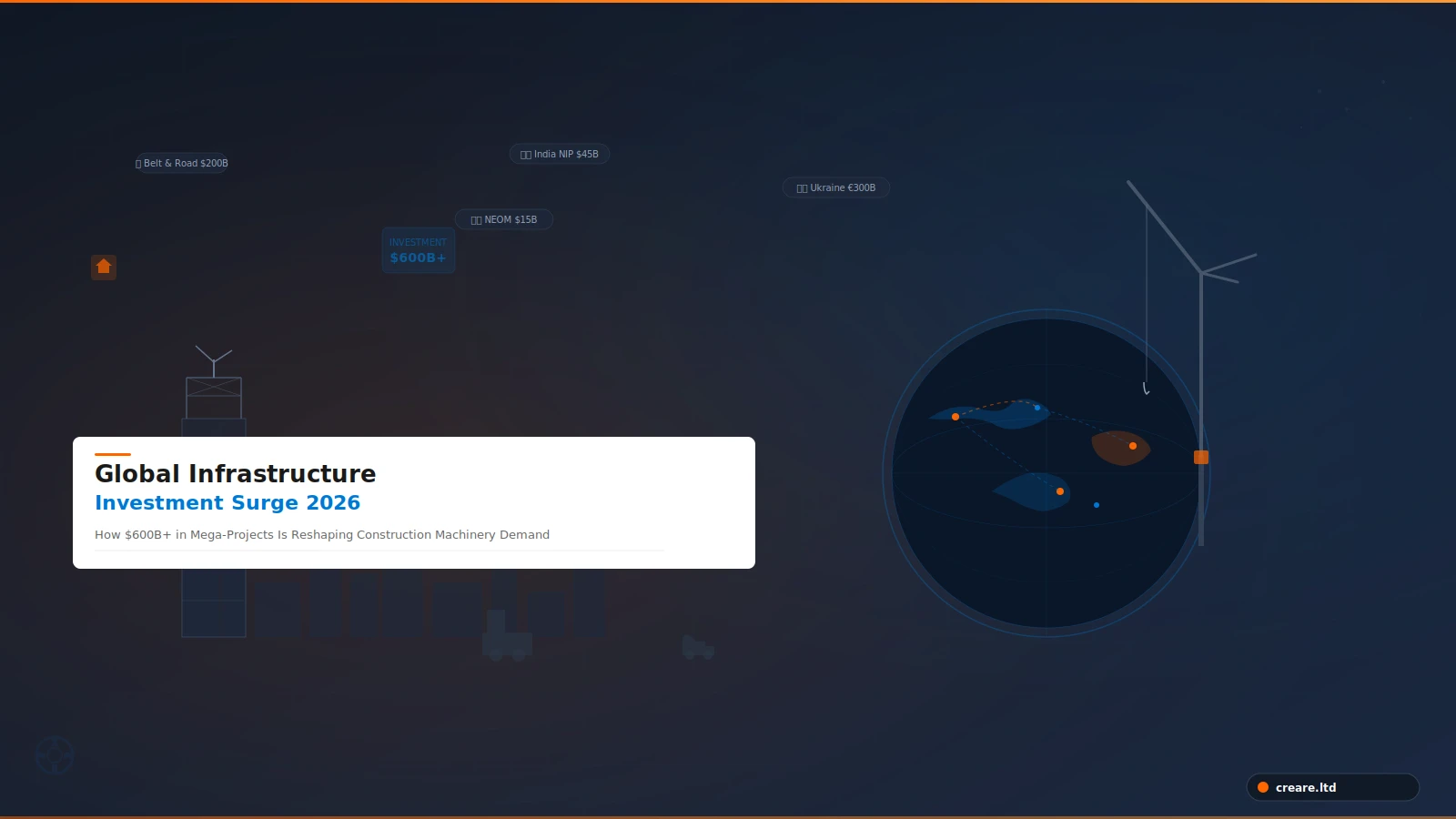



In a single week in late May 2026, governments and multilateral institutions committed over $600 billion to new infrastructure projects spanning four continents. From Ukraine’s postwar reconstruction to China’s Belt & Road expansion, the scale and simultaneity of these commitments is unprecedented — and it signals a fundamental shift in global construction machinery demand that equipment buyers, OEMs, and contractors cannot afford to ignore.
This article examines the five mega-initiatives driving the surge, analyzes how trade policy and steel prices are reshaping equipment costs, and explores why smart construction technologies are becoming essential for contractors competing on these projects.
The last week of May 2026 saw an extraordinary convergence of infrastructure announcements. Here is what happened — and why each matters for construction machinery demand:
At the annual Belt & Road Forum on May 28, China committed $200 billion to roads, railways, ports, and energy projects across 15 countries in Africa and ASEAN. Key projects include a deep-sea port in Kenya’s Lamu corridor and a high-speed rail line in Vietnam (Financial Times). For Chinese construction machinery exporters, this represents one of the largest single-market opportunities in a decade, with demand expected across earthmoving, concrete, piling, and rebar processing equipment.
On May 27, India’s cabinet approved Phase III of the National Infrastructure Pipeline, targeting 12,000 km of new expressways and 20 multimodal logistics hubs (The Economic Times). The scale of road construction alone will require asphalt pavers, soil compactors, motor graders, and concrete batching plants at volumes that could strain regional supply chains. India has historically sourced construction machinery from both domestic manufacturers and Chinese OEMs — a dynamic that this $45bn plan is likely to intensify.
Following a preliminary ceasefire framework, the European Union announced a conditional €300 billion recovery package on May 31 aimed at rebuilding Ukraine’s destroyed roads, bridges, energy grids, and housing stock (BBC News). The procurement requirements are staggering: analysts estimate the package will demand tens of thousands of units of heavy construction machinery — from excavators and bulldozers to concrete pumps and rebar processing lines. European manufacturers alone cannot meet this demand on the required timeline, opening a significant window for competitively priced equipment from Chinese manufacturers.
Saudi Arabia’s NEOM project awarded $15 billion in construction contracts on May 28 for the first residential and infrastructure segment of “The Line” linear city (Arab News / MEED). The contracts cover earthmoving, piling, and tunneling — all equipment-intensive activities. International firms from Europe, China, and Korea are actively bidding for equipment supply contracts, making this a competitive but high-value market for machinery exporters.
On May 30, the US and EU reached a provisional agreement to fully remove Section 232 tariffs on steel and aluminum, replacing the current tariff-rate quota system with a “green steel club” framework (Reuters). Steel represents 40–60% of heavy machinery manufacturing costs, so this deal directly improves margins for equipment manufacturers on both sides of the Atlantic — and signals that trade policy is moving in a direction favorable to construction equipment supply chains.
| S | Strengths |
|---|---|
| S |
|
| W | Weaknesses |
| W |
|
| O | Opportunities |
| O |
|
| T | Threats |
| T |
|
Beyond the raw volume of infrastructure spending, a parallel shift is reshaping how construction machinery is designed, deployed, and evaluated. Academic and industry research published in 2026 highlights three technology trends that are directly relevant to equipment sourcing decisions on mega-projects:
A 2026 study by Tsutsumi, Itsuka, Kasahara et al. published on arXiv demonstrated coordinated control of multiple construction machines using LLM-generated behavior trees with flag-based synchronization (arXiv:2602.01041). The research showed that natural-language task descriptions could be translated into synchronized multi-machine workflows — a capability that directly addresses the coordination challenges of large infrastructure sites where dozens of machines operate simultaneously. For contractors bidding on NEOM or Ukraine reconstruction projects, this technology promises measurable reductions in idle time and fuel consumption.
Tsukagoshi, Sugai, and Uchimura presented at the 2026 IEEE International Conference on Advanced Motion Control (AMC) their work on adaptive path optimization for construction machinery in variable sediment conditions. The research addresses a real-world problem on infrastructure projects: how equipment navigates changing ground conditions without manual reprogramming. This is particularly relevant for earthmoving operations on Belt & Road projects in Africa, where soil conditions can vary dramatically within a single site.
Sutar’s comprehensive review of automation and robotics in construction industries, published in the International Journal of Emerging Science and Engineering (2026), catalogs the current state of robotic construction equipment — including automated rebar tying, robotic concrete finishing, and autonomous compaction. The review concludes that while full autonomy remains niche, semi-autonomous assistive functions (collision avoidance, precision grading, automated quality monitoring) are becoming standard expectations on large-scale projects.
Collectively, this research points to a clear trend: the contractors winning bids on mega-projects are increasingly expected to deploy equipment with telematics, automation, and digital integration capabilities. Equipment buyers who invest in smart-capable machinery today are positioning themselves for the project pipeline of the next decade.
Based on the project mix across Belt & Road, India NIP, Ukraine reconstruction, and NEOM, the following equipment categories are projected to see the strongest demand growth through 2028:
Henan Creare Electromechanical Equipment Co., LTD specializes in concrete finishing machinery and rebar processing equipment — two categories directly aligned with the project profiles described above. Contact our team for equipment specifications and bulk pricing.
The surge in project commitments is good news for demand — but equipment buyers must also track the supply-side disruptions that affect availability and pricing:
Crucially, a 2026 study by Celik, Şensoy, and Sezer published in the journal Lubricants on lubricant selection and lubrication intervals for heavy-duty construction machinery operating under high-temperature conditions provides timely guidance for equipment deployed on Middle Eastern and African infrastructure projects. Their findings demonstrate that proper lubricant selection can extend pin-bushing bearing service life by 40–60% in high-temperature environments — a practical consideration for machinery operating on NEOM or Belt & Road projects in tropical climates (Lubricants, 2026).
China’s $200bn commitment through the Belt & Road Initiative creates sustained demand across 15 countries. Equipment sourcing patterns favor cost-competitive Chinese OEMs, particularly for concrete machinery, rebar processing equipment, and earthmoving machinery. Contractors should expect 3–6 month lead times and plan logistics around evolving port infrastructure in recipient countries.
India’s 12,000 km highway expansion and 20 logistics hubs will absorb road construction equipment at scale. India has historically maintained a balanced sourcing approach between domestic and international OEMs. Chinese manufacturers with established distribution networks and competitive pricing are well-positioned, though import duties and local content requirements should be factored into cost models.
The Ukraine reconstruction package represents the largest single-country infrastructure opportunity in Europe since World War II. With European OEMs at near-capacity and lead times extending, there is a time-sensitive window for Chinese and Asian manufacturers to supply concrete machinery, rebar processing equipment, and earthmoving machinery. The conditional nature of the EU package (tied to ceasefire durability) introduces political risk, but the scale of demand means preparatory sourcing discussions are already underway.
NEOM’s $15bn Phase 1 contracts confirm that Gulf mega-projects continue to advance despite global economic headwinds. The project’s scale and technical requirements favor equipment suppliers who can demonstrate reliability, after-sales support, and smart technology integration. This is a premium market where quality and service support command a premium over pure price competition.
Construction machinery demand is surging due to an unprecedented convergence of mega-infrastructure projects: China’s $200bn Belt & Road expansion, India’s $45bn National Infrastructure Pipeline Phase III, Ukraine’s €300bn postwar reconstruction package, and Saudi Arabia’s $15bn NEOM contracts — collectively over $600 billion in commitments within a single week.
Steel represents 40–60% of heavy machinery manufacturing costs. The US-EU deal to end Section 232 tariffs (May 2026) lowers input costs for transatlantic manufacturers. Conversely, India’s 45% iron ore export duty pushed global billet prices up 12% within a week, raising costs for Asia-based machinery producers.
Road-building equipment, concrete machinery (batching plants, pumps, power trowels), earthmoving equipment, piling/foundation machinery, rebar processing equipment (bending, cutting, straightening machines), and material handling equipment are all projected to see significant demand increases across the four major project regions.
Yes. 2026 research demonstrates that LLM-based coordinated control, adaptive path optimization, and semi-autonomous functions provide measurable ROI through reduced idle time, lower fuel consumption, and improved multi-machine coordination on large infrastructure sites. Smart-capable equipment is increasingly required for mega-project tenders.
The EU’s €300bn package requires massive equipment volumes that European OEMs alone cannot meet on the required timeline. Chinese manufacturers, who offer cost-competitive equipment with shorter lead times, are well-positioned to supply concrete machinery, rebar processing equipment, and earthmoving machinery, though political and regulatory considerations must be managed.
The reduction to 24 daily transits (from 32) has pushed spot freight rates for Asia-to-US East Coast shipments up 28% in a single week. Equipment buyers should budget 15–20% above current shipping rates and plan for 2–4 weeks of additional lead time for trans-Pacific deliveries.
Henan Creare Electromechanical Equipment Co., LTD supplies concrete finishing machinery and rebar processing equipment to contractors and distributors worldwide. With competitive pricing, reliable quality, and export-ready logistics, we help you meet project timelines — even on the most demanding infrastructure projects.
Sources: Reuters, Financial Times, BBC News, The Economic Times (India), Bloomberg, Arab News / MEED, IEEE AMC 2026, arXiv, International Journal of Emerging Science and Engineering, Lubricants (MDPI, 2026). All news items verified against published reports dated May 25 – June 1, 2026. Academic citations verified via Semantic Scholar and publisher databases.