Book Categories:

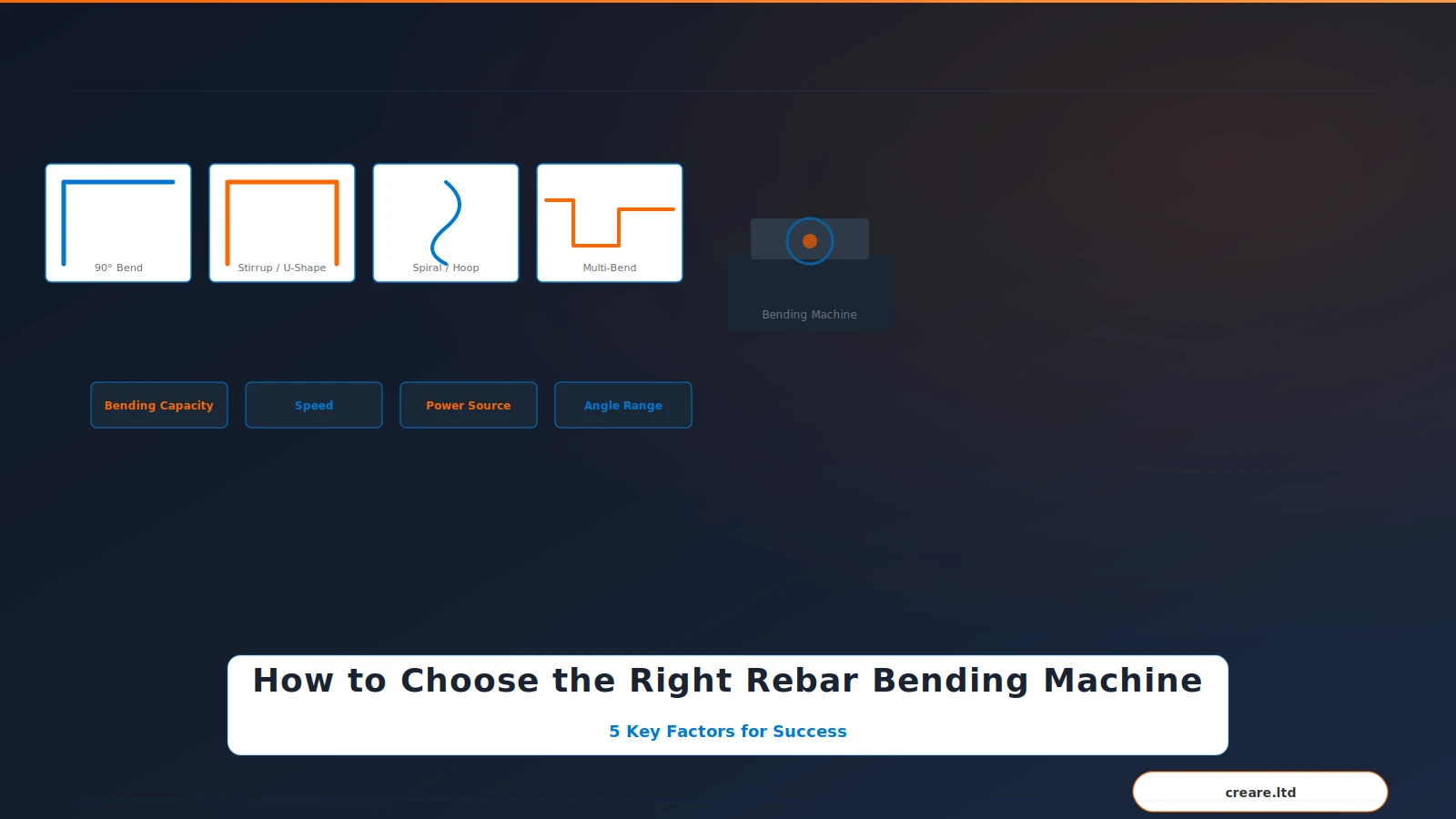
Choosing the right rebar bending machine is one of the most important equipment decisions for any construction company, precast concrete plant, or rebar processing workshop. The right machine improves productivity, ensures bending accuracy, and reduces operator fatigue — while the wrong one leads to bottlenecks, rework, and unnecessary costs.
At Henan Creare, we manufacture a full range of steel bar bending machines — from compact 2.2kW high-speed benders to heavy-duty 5.5kW industrial models with 60mm bending capacity. This guide walks you through the 5 critical factors to consider before making your purchase.
Factor 1: Bending Capacity — What Diameter Do You Need?
The first and most important specification is maximum bending diameter. Rebar bending machines are rated by two numbers:
- Plain round bar capacity: The maximum diameter of smooth steel bar the machine can bend (e.g., Φ40mm)
- Deformed rebar capacity: The maximum diameter of ribbed/high-strength rebar (e.g., Φ32mm)
As a rule of thumb, deformed rebar capacity is about 20-30% lower than plain bar capacity because HRB400/500 rebar is significantly harder to bend.
| Machine Model | Plain Bar Max | Deformed Rebar Max | Best For |
|---|---|---|---|
| RB18-E22 | Φ18mm | Φ14mm | Small workshops, stirrup bending |
| RB40/32-E30 | Φ40mm | Φ32mm | Medium construction sites |
| RB50/36-E40 | Φ50mm | Φ36mm | Heavy infrastructure projects |
| RB60-E55 | Φ60mm | Φ50mm | Bridge, dam, industrial |
Tip: Always choose a machine rated at least 20% above your typical maximum rebar diameter. This gives you headroom for occasional larger jobs and reduces wear on the machine.
Factor 2: Bending Speed — Manual vs High-Speed Electric
Rebar benders come in two speed categories:
Standard Speed (Manual Angle Setting)
Traditional models like the RB40/32-E30 series use a turntable mechanism with manual angle preset. Typical speed: 15-25 bends per minute. Best for: general construction work where speed is not the primary concern.
High-Speed (Automatic Angle Control)
Models like the RB18-E22, RB22-E30, and RB32-E40 feature automatic angle control with higher RPM motors. Typical speed: 40-60 bends per minute — 2-3x faster than standard models. Best for: rebar processing centers, precast factories, and high-volume stirrup production.
Creare’s recommendation: For job sites bending less than 500 pieces per day, a standard-speed model is sufficient. For production shops bending 1000+ pieces daily, invest in a high-speed or CNC model.
Factor 3: Power Source — Electric Motor Considerations
All Creare rebar bending machines are electric-powered (no hydraulic models in our current line). Key considerations:
- 2.2kW – 3kW motors: Suitable for Φ18-32mm rebar. Standard single-phase or three-phase power. Lightweight and portable.
- 4kW motors: Mid-range for Φ40mm rebar. Requires three-phase power. Balances power and efficiency.
- 5.5kW motors: Heavy-duty for Φ60mm rebar. Industrial three-phase supply required. Maximum bending force.
Feature to look for: The RB40/32-E30B PRO model includes a brake motor — the turntable stops instantly when the foot pedal is released, giving precise angle control and improved safety.
Factor 4: Bending Angle and Range
Different projects require different bend angles:
- 0° – 180°: Standard range on all Creare benders. Covers 90° hooks, 135° stirrups, and 180° U-bends.
- Arc bending: For curved rebar (tunnel linings, circular columns), you need a dedicated steel arc bending machine like the GRB32/28-E37, which continuously bends rebar into circular arcs.
All Creare bending machines feature an adjustable angle stopper and graduated angle dial for repeatable, accurate bends.
Factor 5: Build Quality and Durability
When evaluating a rebar bender, inspect:
- Turntable material: Should be cast steel or forged alloy — not cast iron, which can crack under repeated impact.
- Gear transmission: Helical or spur gear with hardened teeth. Creare uses heat-treated alloy steel gears for extended service life.
- Frame construction: Welded steel plate frame, minimum 8-10mm thickness for rigidity.
- Motor brand: Creare uses reputable Chinese motor brands with copper windings (not aluminum) for reliable performance.
Bonus: CNC vs Manual — When to Upgrade
For workshops processing multiple bend angles and shapes in high volume, CNC-controlled bending machines offer:
- Programmable angle sequences
- Digital angle display (±1° accuracy)
- Reduced operator skill requirements
- Higher throughput for complex work
Creare’s CNC models combine the proven mechanical platform with digital control systems. Contact us to discuss your requirements.
Key Takeaways
- Match capacity to your rebar size — with 20% headroom
- High-speed models pay for themselves at 1000+ bends/day
- Check your power supply before choosing motor size
- Inspect build quality — cast steel turntable, hardened gears, rigid frame
- Arc bending requires a dedicated machine
Ready to buy? Browse our full range of steel bar bending machines or contact Creare for a customized quote with OEM options and wholesale pricing.