Book Categories:

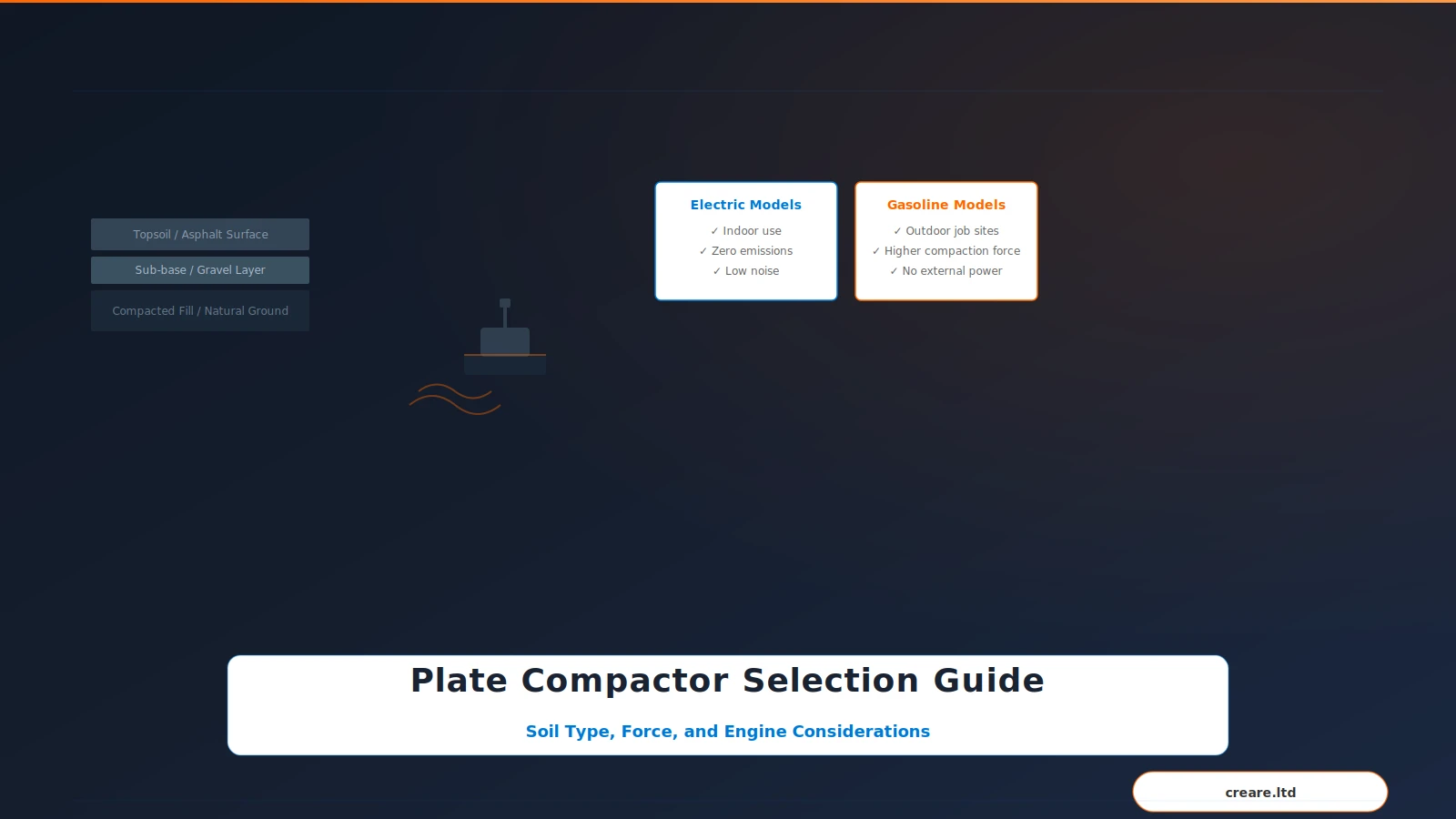

Soil compaction is a critical step in virtually every construction project — from building foundations and road bases to utility trenches and landscaping. Using the wrong compactor for your soil type leads to inadequate compaction, future settlement, and costly rework.
Creare manufactures 7 plate compactors and rammers ranging from a lightweight 60kg vibratory plate to a 165kg reversible heavy-duty compactor, plus a jumping jack frog rammer and electric models for indoor use. This guide explains how to match the machine to your material.
Soils fall into two broad categories that require fundamentally different compaction approaches:
Golden rule: Use a vibratory plate for granular materials, a rammer for cohesive soils. Using a plate compactor on clay is slow and ineffective — the vibration cannot break the cohesive bonds efficiently.
| Model | Weight | Type | Best For |
|---|---|---|---|
| ZP-60 | 60kg | Forward, gasoline | Landscaping, pavers, small repairs |
| PC-66G | 66kg | Forward, gasoline | Narrow trenches, pathways, DIY |
| PC-140G | 140kg | Forward, gasoline | Road repair, foundation backfill |
| PC-160E | 160kg | Forward, electric | Indoor/trench — zero emissions |
| PC-160G | 160kg | Reversible, gasoline | Road base, subgrade, heavy soil |
| PC-165G | 165kg | Reversible, gasoline | Highway base, airport, heavy civil |
Forward-only compactors (ZP-60, PC-66G, PC-140G, PC-160E) move in one direction. The operator must physically turn the machine at the end of each pass. Best for: smaller areas, narrow trenches, and projects where maneuverability matters more than speed.
Reversible compactors (PC-160G, PC-165G) can move forward and backward via a hydraulic directional control. The operator simply shifts a lever to reverse direction — no turning required. Up to 40% faster on large open areas. Best for: road bases, large foundations, and any project over 200 m².
Heavier plates deliver deeper compaction. As a general guideline for granular soils:
The PC-160E is Creare’s electric plate compactor — a specialized tool for situations where gasoline engines are not acceptable:
The trade-off: you need access to mains power (or a large generator) and a heavy-duty extension cord rated for the motor’s current draw.
For cohesive soils — clay, silt, and mixed soils in trenches — vibratory plates are insufficient. Tamping rammers deliver high-impact blows at 10-12 strikes per second, breaking the cohesive bonds that hold clay particles together.
| Model | Impact Force | Engine | Best For |
|---|---|---|---|
| TR-80E | 80kg | Electric | Indoor trench backfill |
| TR-90E | 90kg | Electric | Indoor foundation work |
| TR-95E | 95kg | Electric | Heavy indoor — most powerful electric |
| TR-90G | 90kg | Gasoline | General outdoor trench work |
| TR-100G | 100kg | Gasoline | Demanding cohesive soil compaction |
| TR-110G | 110kg | Gasoline | Maximum impact — tough clay, heavy civil |
The FR-150 frog rammer is a jumping jack variant with a distinctive wide base plate. With 150kg impact force, it’s ideal for cohesive soils in wider trenches where a standard rammer foot is too narrow. The frog-type foot covers more area per impact.
| Your Material | Your Location | Recommended Machine |
|---|---|---|
| Sand, gravel, crushed stone | Outdoor, open area | PC-140G, PC-160G, PC-165G |
| Sand, gravel (small area) | Outdoor, confined | PC-66G, ZP-60 |
| Granular soil | Indoor / enclosed | PC-160E |
| Clay, silt, mixed soil | Outdoor trench | TR-90G, TR-100G, TR-110G |
| Clay, silt | Indoor / enclosed | TR-80E, TR-90E, TR-95E |
| Cohesive clay (wide trench) | Outdoor | FR-150 Frog Rammer |
Contact Creare to discuss your soil conditions and get a recommendation with factory-direct pricing.